**<h1>Template Lit: Using Native T-Strings for Safer String Assembly in Python</h1>**

**<h2>Introduction</h2>**
String handling in Python often looks simply, yet it quietly introduces risk. When you build strings dynamically, especially with user input, you open the door to injection flaws, formatting bugs, and subtle data corruption. Template Lit, based on native t-strings, offers a safer way to assemble strings without relying on fragile manual concatenation. Users get better structure, more clarity, and in-built safeguards. Moreover, the performance stays predictable with a clean syntax. One can join the **[Python Online Course](https://www.cromacampus.com/courses/online-python-training-in-india/)** for the best hands-on learning experience in these aspects.
**<h3>What Is Native t-Strings in Template Lit?</h3>**
Template Lit offers a structured string construction approach. In this, T-strings are used to keep literal text and values separated until the final assembly stage. Strings are treated as a sequence of safe fragments. They do not get merged into a single raw string. Each fragment carries context.
You can think of a t-string as a container. It understands parts that are static and parts that come from variables. Such a separation reduces accidental formatting issues or vulnerability injection in systems. Furthermore, runtime can apply validation rules before the final output is generated.
**<h3>Why Traditional String Assembly Fails</h3>**
Accurate ordering, escaping, and formatting consistency is vital when combining the strings manually. This process generates errors during interactions with APIs or databases.
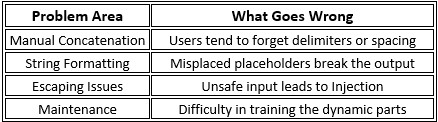
Template Lit helps users prevent the above issues. It applies structure rather than simply relying on discipline.
<h3>Internal Mechanics of Template Lit</h3>
Template Lit does not immediately generate a final string. An intermediate representation is generated to hold the tokens for literals and expressions.
Token is a unit of data. It represents a specific part of the string.
The system processes each token safely during rendering. Inputs get sanitized, types are validated. It also transforms values before they get combined. This delayed evaluation model is the core strength of t-strings.
Immutability is another important concept. The structure does not change after t-string is defined. As a result, behaviour become more predictable and side effects during execution are reduces significantly.
**<h3>Safety Model and Injection Resistance</h3>**
The right design improves safety in Template Lit. The system does not trust dynamic values blindly. It treats them as data rather than executable content.
![Uploading file..._3tar4rldg]()
The above method reduces SQL injection or cross-site scripting. Moreover, users do not need to write extra defensive logic.
Beginners can join the **[Best Python Training in Noida](https://www.cromacampus.com/courses/python-training-in-noida/)** for ample hands-on training opportunities based on the latest industry patterns.
**<h3>Performance Considerations</h3>**
Template Lit balances safety with efficiency. It avoids repeated string copying. This makes Template Lit more memory-efficient than concatenation.
Optimization improves with token-based model. The static parts get cached while the dynamic segments are evaluated. As a result, overhead in repeated operations reduce significantly.
**<h3>Practical Use Cases</h3>**
Template Lit is best suited for systems that build strings frequently and require high security. Such systems include the following:
• API Responses
• Configuration Generation
• Logging Pipelines
• Templated Content Rendering
Systems become more readable with Template Lit. users can monitor the parts of string that are fixed and parts that need runtime values. This improves debugging and cognitive load reduces.
**<h2>Conclusion</h2>**
Template Lit and native t-strings shift how you think about string assembly. Instead of treating strings as flat text, you treat them as structured data. This small shift gives you stronger safety, better maintainability, and more predictable behaviour. The **[Python Coaching in Delhi](https://www.cromacampus.com/courses/python-training-in-delhi/)** is designed for beginners and offers the best guidance from scratch. If you build systems where correctness and security matter, adopting this model is not just helpful, it is a practical upgrade.
**FAQs**
**1. What makes t-strings safer than normal string formatting in Python?**
T-strings keep your text and your data separate until the final step. That sounds small, but it changes everything. You don’t directly mix user input with raw strings. Instead, the system treats input as data, not executable content. Injection risks reduce significantly.
**2. Do you need to learn complex syntax to use Template Lit effectively?**
Not really. You don’t deal with heavy syntax or confusing rules. The idea stays simple: write your static text, then plug in dynamic values safely. Template Lit handles the internal structure for you. It effectively manages tokens.
**3. When should you actually use t-strings in real projects?**
T-strings are useful when working with strings that contain dynamic or user-driven data. These include APIs, logs, database queries, UI content, etc. T-strings maintain the safety and consistency across systems even when strings undergo change. As a result, users can prevent errors and bugs that occur from minor mistakes.